Style Instead of Glamour in Willy Decker's La Traviata
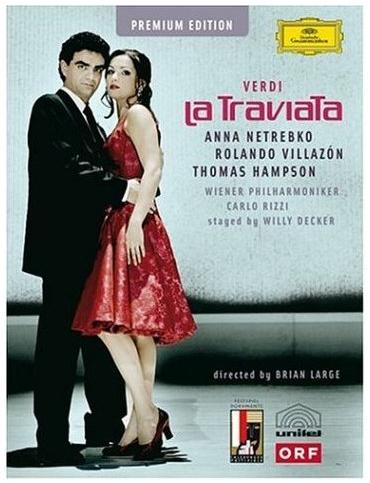 G. Verdi, La Traviata, Rizzi, Decker, Netrebko, Villazon, Hampson et al. |
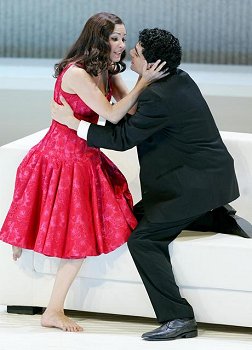 And we react to her, because she is – foremost – stunningly beautiful, sexy and attractive. “We,” because classical music, more so still than other trades, is largely driven by the actions and opinions of men, “we” because those among us that are not heterosexual lustmongers who have channeled their urges into expressing through or appreciation of art are homosexual aesthetes similarly taken in by grace and good looks. “We,” because the kind of beauty generated by Netrebko in this particular setting is of a kind that transcends gender and sexuality. We all react to that which pleases the eye and imagination. And when the visual feeds into heart or groin, the ear will nod in timid agreement, little matter the fare it is served. In a sense, Netrebko is like a restaurant of great repute with the finest décor – where the food is good (never more) but all the right people meet. We take it as the greatest joy – and rightly so: let’s not feel guilty for being charmed by that which was designed by nature (and marketing people) to charm us. La Traviata with Netrebko is a sensual feast and deserves to be embraced as a whole.
 But what makes this Traviata great, is the direction, the set, and the acting. True, Netrebko has a tendency to over-act and forget the singing while she is at it, busily wiggling her toes or attempting somersaults. Fortunately here she does not attempt such feats. Against the wide, white semicircle that encloses the stage (a dream in simple elegance of design and texture) her reds and blacks are as vivid as lip-stick smears on champagne glasses and tuxedos. Her torment, too, becomes believable – not via a stuffy setting from the olden days but because the direction takes the drama from the social surroundings into Violetta Valéry herself – juxtaposed by a father-figure representing Death or Fate which is, in her case, one and the same. And while Violetta is a well-established modern woman, aware of her charms and what she can make men do because of them, she succumbs to a deeper self, the inner child that wishes itself a past innocence with wide and begging eyes, that still wishes to believe in all those things that her cynical veneer has long cast to the four winds. It is this that makes her believable to us, because we believe in an inner naturalness that does not feel like a merely acted front like with, for example, the insufferably self-obsessed Angela Gheorghiu.
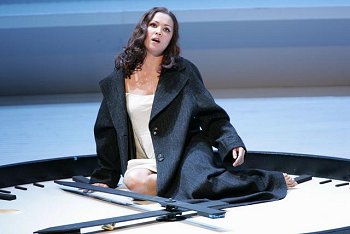 Speaking of insufferably self-obsessed: Thomas Hampson is a very fine Germont and Villazón’s Alfredo meets Netrebko’s acting every step of the way: innocent, helplessly nasty, broken, and lovelorn. No actor could probably make his initial obsession seem real, but that part of the opera is quickly gotten past. What remains are two hours of opera as it should be: involving, beautiful, musical, a drama even the un-inclined are willing to follow, mainly because it casts out the dusty scraps that ‘tradition’ thoughtlessly passes down and instead successfully focuses on a very few, but the right essentials: beauty, emotion, and – of course – music. (Carlo Rizzi and the Vienna Philharmonic apply the necessary musical touches.) For those who don’t fall for the empty glitz of Zefirelli productions, Willy Decker's on this DVD is mandatory viewing and makes the CD alone not worth owning.